The short answer: about two metres back, not a few feet. Against the glass a south window reads roughly 13,000 lux and the engine scores a moth orchid 64/100. At one metre it is 10,000 lux and 66. The flag clears at two metres, where 6,300 lux scores 94. Google’s summary of this question today puts the move at two to three feet from the sill, which is less than half of it: at a metre, already further than that advice asks for, this plant has only gone from 64 to 66.
The results page for this question disagrees with itself in a polite way. The summary at the top says orchids can thrive in a south-facing window provided you filter the strong light, and suggests pulling the plant a few feet back from the glass. Below it, the American Orchid Society puts south and east windows at the top of its list. Below that, an orchid group thread asks plainly why everyone is so frightened of a sunny window.
They are not really arguing. They are describing different spots and calling them all “a south window”.

Worth a try
It can work here with a little care.
A bit bright, but workable
Comfortable temperature
Humidity suits it
Airflow isn't quite ideal
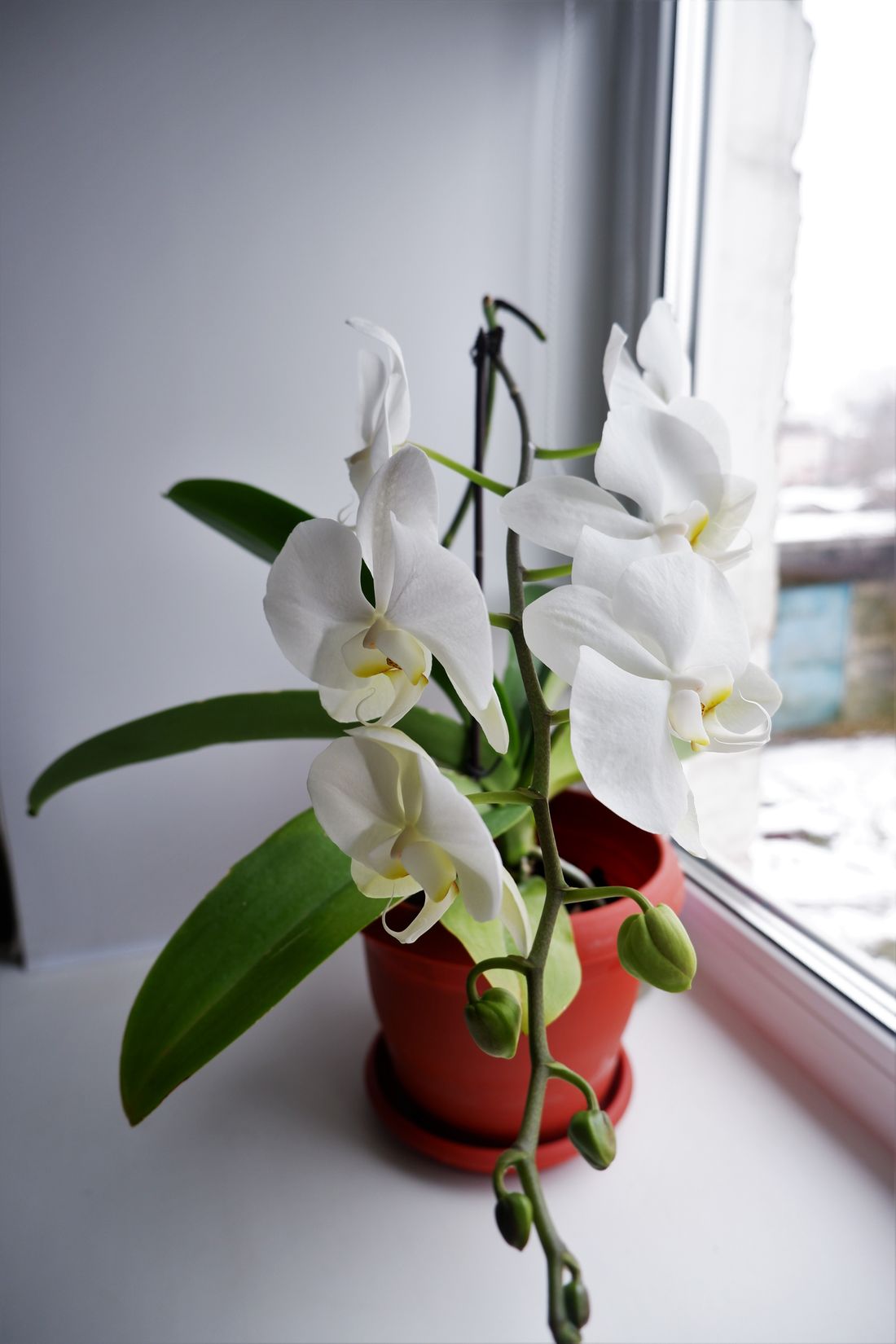
Can a phalaenopsis live in a south-facing window?
Before our own scoring says anything: we gathered every published figure we could find for an orchid. 6 of them, from 5 separate sources, in 2 different units. They are reproduced below exactly as each source writes them, and nothing here is converted.
| Who publishes it | What it says a orchid needs | What the figure is |
|---|---|---|
| growlightmeter.com | 4 – 8 PPFD / DLI | Orchid |
| staugorchidsociety.org | about 10,000 foot-candles | full sun equivalent, stated as too bright for most orchids |
| houseplantjournal.com | 200 FC (40 µmol) foot-candles | minimum indirect light level |
| houseplantjournal.com | 400 FC (80 µmol) foot-candles | good indirect light level |
| houseplantsnook.com | 100–200 foot-candles | chart fc level |
| soltech.com | 40+ PPFD / DLI | minimum fixture PPF to support flowering houseplants |
Yes, at two metres back, where it scores 94/100 with the light sitting comfortably inside the band this plant wants — and not on the sill: the glass is 64/100 and one metre is 66/100, both flagged, which here means bright but survivable rather than fatal.
So the honest version of the advice is not avoid south windows, and it is not south windows are best. It is: use the room, not the ledge.
The numbers by distance
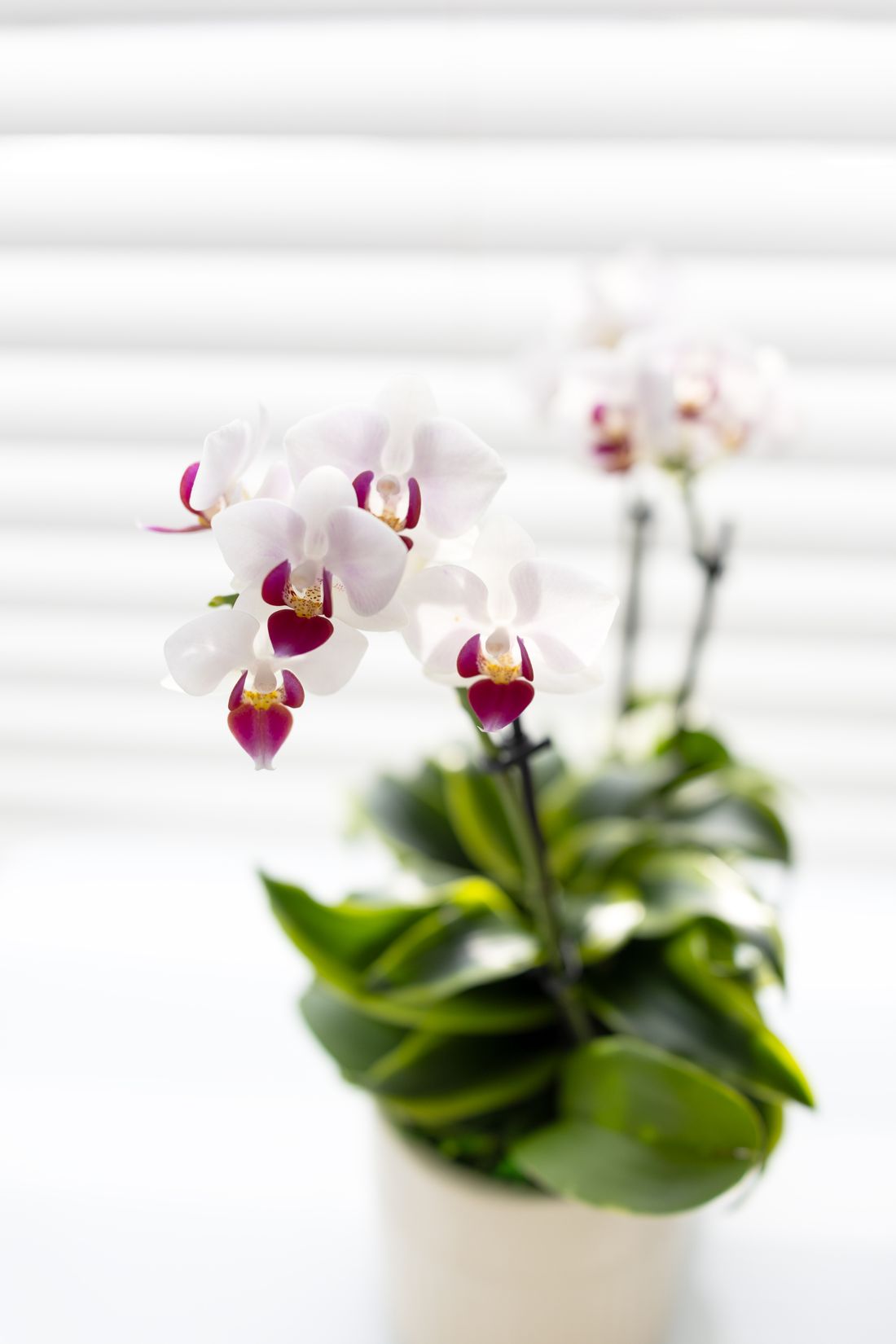
Two metres, which is about six and a half feet: 64/100 at the glass, 66/100 at one metre, then 94/100 at two metres and three alike. The same orchid, the same window, four distances:
| Distance from the glass | Estimated light | What the light is doing | Verdict |
|---|---|---|---|
| 0.3 m, against the glass | 13,000 lux | A bit bright, but workable | Worth a try, 64/100 |
| 1 m back | 10,000 lux | A bit bright, but workable | Worth a try, 66/100 |
| 2 m back | 6,300 lux | Just the right amount of light | Great fit, 94/100 |
| 3 m back | 3,969 lux | Just the right amount of light | Great fit, 94/100 |
Those light figures are estimates rather than meter readings. They come from the window direction, the distance, and typical clear-day conditions, and you can run the same check on your own window for free if you want the version that uses your city’s weather instead of a clean assumption.
What “a few feet back” leaves out
The usual figures — a few feet, or two to three feet back from the sill — are all under a metre, and at a metre this plant is still flagged at 66/100. Two metres, closer to six and a half feet, is where the score jumps to 94/100.
The same advice will tell you a phalaenopsis needs more shade than a cattleya or a vanda, and then give it the shortest distance of the lot. Scored, the order holds but the numbers do not: a philodendron at this same south window does not reach 100/100 until three metres, and this orchid does not clear its flag until two.
There is a second thing the advice tends to skip. In a still room this plant also gets flagged on airflow. Moth orchids are epiphytes, they grow with their roots in moving air rather than buried in soil, and a sealed room with the windows shut is a condition they notice. It will not kill a plant that is otherwise well placed, and it is a reason a bathroom with an extractor fan often suits them better than a closed spare bedroom.
Why the guidance splits in the first place
Because the harm is slow rather than dramatic: the sill scores 64/100, a flag and not a failure, so nothing looks wrong for months. Phalaenopsis evolved under a canopy, attached to bark, taking bright light that had already been broken up by leaves above. Direct midday sun through glass is a harsher version of that: leaf temperature climbs, the plant closes down, and you get a stall instead of a scorch mark.
Writing avoid south is safe because it can never be blamed for a dead plant. It also gives away an entire wall of a flat to someone who has only south windows, which is a real cost paid by real people.
The split is not unique to orchids. What else a south window suits is sorted the same way, by position relative to the beam rather than by room.
The other half of the answer is the air
Humidity is what holds this page at 94/100 rather than a hundred: the same two-metre spot is 62/100 at 25% humidity and does not reach 94/100 until 55%. Distance settles the light and then hands you a second problem. A moth orchid asks for 50% humidity and up, which is a wide, high band and one that a heated room in winter does not reach on its own. Here is the two-metre spot again, with everything held still except the humidity:
| Humidity at the spot | Verdict |
|---|---|
| 25% | Worth a try, 62/100 |
| 35% | Good fit, 82/100 |
| 45% | Good fit, 89/100 |
| 55% | Great fit, 94/100 |
| 65% | Great fit, 94/100 |
A dry room takes back most of what the right distance bought you. This is why the honest answer to “where do I put my orchid” is a spot rather than a direction: the same three metres, in two different rooms, are not the same offer.
How it tells you the spot is wrong
- Too much light: leaves take on a yellow-green or reddish cast, and the leaf surfaces facing the glass feel warm to the back of your hand on a sunny afternoon. Move it back a metre.
- Too little light: deep, dark, glossy green leaves and no flower spike for a year. Dark leaves look healthy and read as thriving, which is why this failure runs for so long before anyone notices.
- Limp leaves: almost always roots and water rather than placement. Check the roots before you move the plant.
The room is not the spot
We put a phone down in six places in one living room on a clear afternoon:
| Spot | Reading |
|---|---|
| At the bright window | 20,000 lux |
| 1 m from the window | 15,000 lux |
| 2–3 m away, in window shade | 3,500 lux |
| Middle of the room | 570 lux |
| Darker side of the room | 119 lux |
| The dark corner | 18 lux |
That room’s orientation was never written down, so those are not south-window figures and we are not presenting them as any. What carries over is the steepness. The readings, with the method and the equipment, are in the six-spot measurement.
A single south-facing room, in other words, holds both a ledge that stalls this plant and a spot that suits it, a few paces apart.
Published August 10, 2026 · Last updated August 30, 2026
