On an east sill an Ocean spider plant scores 100 out of 100. That’s at an estimated 6,500 lux, in a room held at 22 °C and 50% humidity. Walk the pot back and the number hardly moves: 99 at two and a half metres, on 2,500 lux. Half a metre further, at 1,984 lux, it drops to 69.
Read on 14 October 2026, the leading results agree that east suits this plant, then split over where it goes. Plant Addicts puts it directly in front of an east or west window. Joy Us Garden keeps it near a window rather than in one, except at north and east. The New York Botanical Garden’s care page wants bright light a short distance from the glass. Only The Plant Manual gives a distance, one to four feet, and warns that eight or ten feet back gets a fraction of the light. None of them says where that stops being enough.
Both placements score the same, so neither camp is wrong. The cautious one gives away most of the good floor, and the eight-or-ten-feet warning straddles the exact spot where the score falls.

Great fit
This plant should be happy in this spot.
Just the right amount of light
Comfortable temperature
Humidity suits it
Airflow suits it
Can a spider plant sit right on an east windowsill?
Yes. In the card above all four markers sit inside their bands at the glass. Before our numbers go further, this is what other sources publish as a spider plant’s light need. Most of it is in foot-candles, and none of it is converted:
| Who publishes it | What it says a spider plant needs | What the figure is |
|---|---|---|
| growlightmeter.com | 5 – 10 PPFD / DLI | Spider Plant |
| extension.arizona.edu | 75–150 foot-candles | listed under the heading "Medium Light (75–150 fc)" |
| houseplantjournal.com | 200 FC (40 µmol) foot-candles | minimum indirect light level |
| houseplantjournal.com | 400 FC (80 µmol) foot-candles | good indirect light level |
| houseplantsnook.com | 100–200 foot-candles | chart fc level |
Those are levels; the search results are about places. Our east-sill estimate is 6,500 lux, well inside this plant’s band, and it stays inside all year: scored on the 21st of every month at 40 degrees north, the sill never leaves a great fit. The morning beam is what makes people hedge. At an east window it arrives while the room is at its coolest, so the sill doesn’t stack heat on top of light the way a west one can.
Plenty of plants on east-window lists don’t get that at the sill. A snake plant gets flagged on an east sill and only clears that flag a metre back, and a ZZ plant is flagged there from spring to early autumn. Both are built for less light than a spider plant wants. This one needs more, and the sill is where an east room keeps it.
Hanging it changes nothing. A basket in the window opening is as close to the glass as the sill, so it scores the same, and here that means the top of the table.
How far back from an east window can a spider plant go?
Just short of three metres, which is a little under ten feet. The table moves the pot and holds everything else:
| Distance from the glass | Estimated light | What the light is doing | Verdict |
|---|---|---|---|
| 0.3 m, against the glass | 6,500 lux | Just the right amount of light | Great fit, 100/100 |
| 1 m back | 5,000 lux | Just the right amount of light | Great fit, 100/100 |
| 1.5 m back | 3,969 lux | Just the right amount of light | Great fit, 100/100 |
| 2 m back | 3,150 lux | Just the right amount of light | Great fit, 99/100 |
| 2.5 m back | 2,500 lux | Just the right amount of light | Great fit, 99/100 |
| 3 m back | 1,984 lux | A little dim, but workable | Worth a try, 69/100 |
| 5 m back | 787 lux | A little dim, but workable | Worth a try, 63/100 |
Between the glass and 2.5 m the estimate falls from 6,500 lux to 2,500 and the score gives up one point. Between 2.5 and 3 m it gives up thirty. Rescored in ten-centimetre steps, 2.9 m still holds a great fit, so the edge is a line on the floor rather than a slope.
Lay the search results over that line. The Plant Manual’s one to four feet ends around 1.2 m: safe, and less than half the floor this plant scores a great fit on. Its eight-or-ten-feet warning sits right across the line. Eight feet is 2.4 m, inside the run. Ten feet is just past the 3 m row.
Past the line the slide is slow. Five metres in still reads worth a try at 787 lux, where a north room at the same depth drops this plant out of the workable band.
The lux numbers in that table are modelled, not metered: compass direction plus distance, under a clear sky. A tree or the building opposite pulls the line in toward the glass.
Does an east window still work for a spider plant in winter?
At the glass, yes. The far end of the run is another matter once the days shorten. Here’s the 2.5 m spot, the last 99 in the first table, scored through the year at 40 degrees north, the line that runs through Madrid and Philadelphia:
| The month it is | Estimated light | What the light is doing | Verdict |
|---|---|---|---|
| January | 1,419 lux | A little dim, but workable | Worth a try, 66/100 |
| February | 1,930 lux | A little dim, but workable | Worth a try, 69/100 |
| June | 3,000 lux | Just the right amount of light | Great fit, 99/100 |
| October | 1,894 lux | A little dim, but workable | Worth a try, 68/100 |
| November | 1,403 lux | A little dim, but workable | Worth a try, 66/100 |
| December | 1,250 lux | A little dim, but workable | Worth a try, 65/100 |
From March to September that spot holds a great fit, while October and February read a little dim, at 1,894 and 1,930 lux, and score 68 and 69. November drops it to 66 and December to 65, and January is still at 66. For five months it gets less light than the 3 m row does in the first table.
Nearer the window the change is small. Rescore the sill across all twelve months and it never leaves a great fit, and the 1.5 m spot leaves it only in December. So the one to four feet from the search results is the all-year zone, and the extra floor out to eight feet is good from March to September. A pot that never moves is safe at four feet. One at eight wants bringing in from October through February.
A north window asks for more: there the plant has to move right up to the glass from October to February. Further north the east run shrinks as well. At 51 degrees, about London, the 1.5 m spot drops a band from November to January, while the east sill still holds.
Is east the best window for a spider plant?
It’s the easy one. On light alone a west window matches it and reaches a little further into the room, but this plant drops a band on warmth at 27 °C, and the west page follows what a hot afternoon does to it. A south window has the longest great-fit stretch for it, starting a metre off a sill that gets marked down, and a north one stops at a metre and a half. East gives the sill and the spot eight feet back the same verdict, and takes its direct sun in the coolest hours of the day.
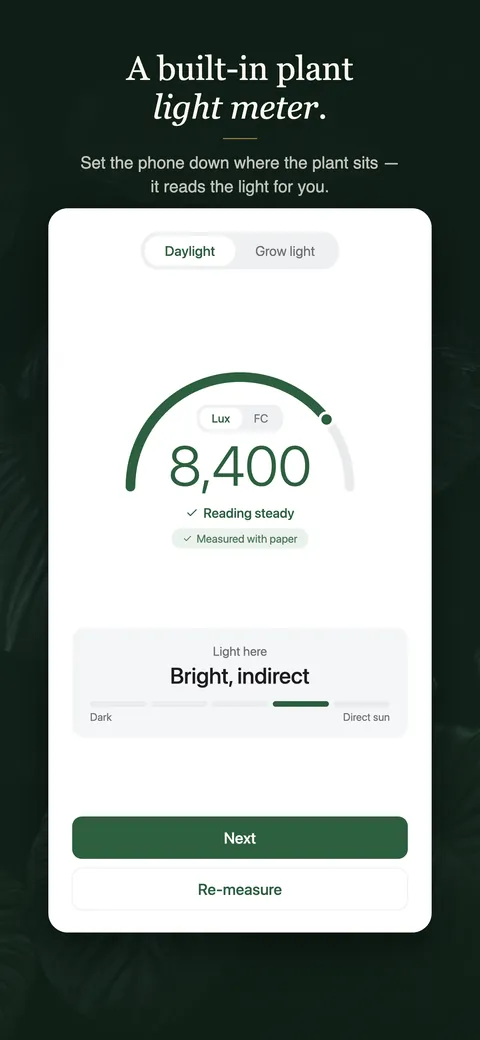
You can find where the run ends in your own room with a phone. The app’s light meter puts the label bright, indirect on readings of at least 2,500 lux and below 10,000, and at an east window that covers every row from the glass out to 2.5 m. If the pot reads bright, indirect, it’s on the right part of the floor.
What can move the line in your room?
Anything between the glass and the sky. A deep eave, a balcony overhead, a street tree or a net curtain each take light off every row above and pull the 3 m line toward the window, and the estimate has no input for any of them. The plant will tell you slowly if it’s past the line: the NYBG guide puts loss of variegation down to light that’s too low, and an Ocean spider plant has stripes to lose. The east window guide sorts what else belongs on this sill and what belongs further back, and the free spot checker will score your actual window, live weather included.
Published October 14, 2026 · Last updated October 19, 2026
