Ask when to repot and you get a season back. Spring, says Penn State Extension; spring or early summer, says Illinois; spring and summer, says Clemson; late winter, says the University of Arkansas, because the light is coming back and the plants are waking up. They are quoted in full further down, and they cannot all be describing the same plant.
GrowSpot has to answer this without asking you anything, so the answer had to become a test rather than a season. There are four conditions in it. Three of them are never mentioned in the advice above, and the one that is mentioned is the one that moves depending on where you live.

Great fit
This plant should be happy in this spot.
Just the right amount of light
Comfortable temperature
A little dry, but workable
Airflow suits it
Spring is not a month. It is a hemisphere.
The app reads the spring window from the latitude of your home area, so the same calendar month is inside the window for one reader and outside it for another. Nothing on the first page of that search makes the distinction, which is a quiet problem for anyone reading northern advice in March in Melbourne.
Read from the check itself, the two windows are March, April and May in the north and September, October and November in the south. Every result on the first page of this search assumes the northern one.
Note what this does to the most common piece of repotting advice in the world. "Repot in spring" is correct for both windows and useful for neither, unless it says which spring. A plant you bought last week sits outside all of this, because the interval it reads starts from your records.
Spring is necessary. It is not sufficient.
Three more conditions sit alongside the calendar, and every one of them can keep the app quiet in the middle of April. Extreme weather is the one people find surprising: if a heat or cold alert is running for a plant standing outside, repotting is held back, on the same reasoning that holds back feeding. Root disturbance is a cost, and you do not want to spend it in the same week as a heatwave.
Here is the whole test, run one condition at a time:
| The situation | Since the last repot | What GrowSpot does |
|---|---|---|
| Spring, and it has been in that pot for years | 30 months | Raises the hint |
| Same plant, but it is autumn where you live | 30 months | Silent: outside the spring window |
| Spring, but you repotted it last year | 12 months | Silent: repotted too recently |
| Spring, and a heat or cold alert is running outdoors | 30 months | Silent: extreme weather outside |
| Spring, but it is planted in the ground | 30 months | Silent: repotting does not apply here |
| Spring, but it is in semi-hydro | 30 months | Silent: repotting does not apply here |
| Autumn, in the ground, repotted last month | 1 months | Silent: repotting does not apply here |
The last row is worth a second look: if repotting does not apply to how the plant is growing, nothing after that matters.
The sign everyone gives you is the one that lies
Every source on that first page lists the same tells: roots out of the drainage holes, roots circling the surface, the plant going over because it is top-heavy, and soil that dries out a day or two after a deep watering. The first three are observations of roots. The fourth is not, and it is the one people act on, because it is the one you notice without doing anything.
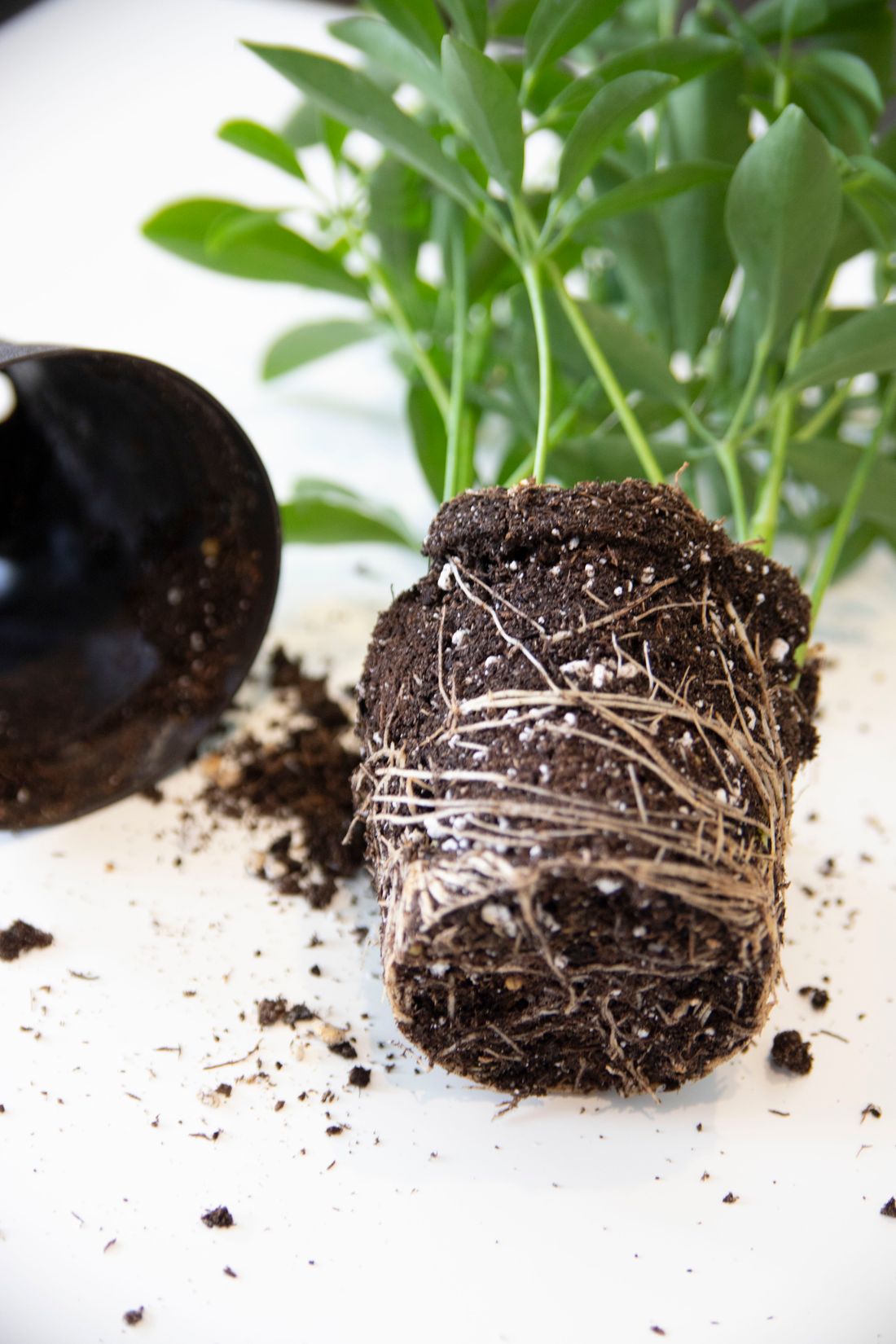
All four of the extension services below publish that fourth sign, and no two of them agree on the month or the interval that goes with it.
| Published by | What it says | On what |
|---|---|---|
| extension.psu.edu | Spring | “The best time to repot a plant is in the spring when it naturally and actively begins its seasonal growth.” |
| extension.illinois.edu | Spring or early summer | “Re-potting is best accomplished when the plant is actively growing. Typically this is done in spring or early summer.” |
| hgic.clemson.edu | Spring and summer | “Repot only as needed during spring and summer while the plant is actively growing”. |
| uaex.uada.edu | Late winter | “it is best to repot in late winter just as the natural light level is increasing and the plants are awakening from their winter doldrums.” |
| hgic.clemson.edu | Yearly to every 2–3 years | “Fast-growing plants may need repotting annually, while slow-growing plants may require repotting every two to three years”. |
| uaex.uada.edu | Every 3–5 years | “few houseplants will need repotting more frequently than once a year, and most will only need repotting once every three to five years.” |
| extension.psu.edu | The drying test | “Do you notice that the potting mix dries out very quickly, even during periods of cooler temperatures?” |
| extension.illinois.edu | The drying test | “The plant wilts between normal waterings.” |
| hgic.clemson.edu | The drying test | “if the plant requires frequent watering or wilts shortly after watering”. |
| uaex.uada.edu | The drying test | “When the plant begins drying out between waterings, repotting may be needed.” |
Drying speed is what our watering maths is built to model, so we can put a number on how far it moves without any roots involved. Pot material, potting mix and the season each scale it, and they multiply:
| Same plant, same room | How fast the pot dries | Gap between waterings |
|---|---|---|
| A glazed pot with ordinary potting mix, midwinter | ×0.5 | ×2 |
| A glazed pot with ordinary potting mix, average day | ×1 | ×1 |
| A terracotta pot with ordinary potting mix, average day | ×1.15 | ×0.87 |
| A terracotta pot with a gritty cactus mix, average day | ×1.44 | ×0.7 |
| A terracotta pot with a gritty cactus mix, high summer | ×3.59 | ×0.28 |
The same plant with the same root ball dries seven times faster at the bottom of that table than at the top. Nothing in those rows is a root. If you moved a plant into terracotta with a grittier mix in April and it started drying out in a day by July, you have reproduced the whole effect without the plant doing anything at all. The watering guide works through the same three factors from the other direction.
This is not an argument that your plant is fine. It is an argument that the drying test cannot tell you either way, so it is worth going and looking at the roots rather than inferring them.
Two containers where the question does not apply
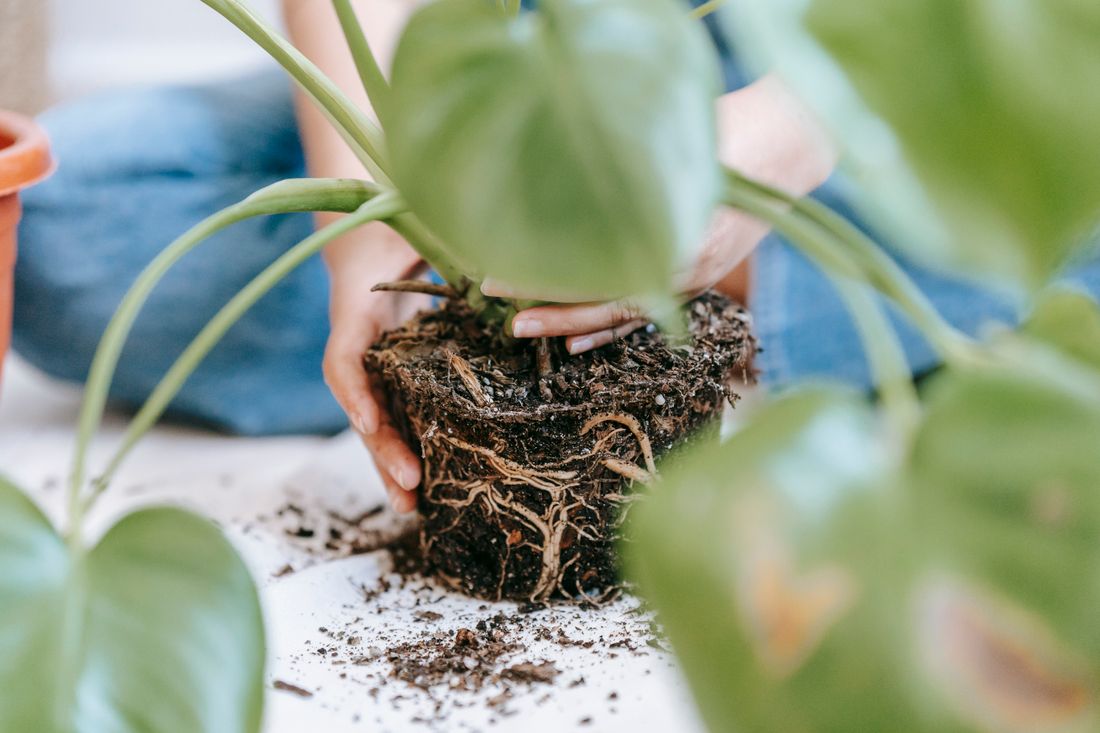
Repotting assumes there is a bigger pot to move to. For two of the six ways people grow things indoors there is not — a plant in the ground and a plant in semi-hydro or water culture — and GrowSpot never raises the hint for either.
Mounted plants are the interesting exception. A staghorn fern on a board does get moved to a bigger board, so the check still runs, but the pot-width rule has nothing to read, because a slab has no diameter. That is one narrow rule declining to apply itself rather than an entire feature switching off.
What to do with your own plant
Wait for your own spring, not the one in the article. Then check the roots rather than the soil, because the soil has three other explanations. If the plant is in the ground or in water, stop reading about repotting. And if there is a heat or cold snap in the forecast, let it pass first, since the plant has nowhere to recover to. That alert is one of five the app watches, and only two of them follow a plant indoors.
Where the plant stands is a separate question, and it is the one that decides whether it grows at all afterwards. You can put a number on that in about a minute with the free spot checker, no download, or work through the light check first if the plant has been sulking.
The thresholds and windows above are read out of the repotting check itself, and the per-species anchor it starts from is held between 12 and 48 months. We do not publish that anchor for individual species, because those values were machine-filled rather than curated. Drying multiples come from our watering model, calibrated against our own plants.
By GrowSpot · Published August 15, 2026 · Last updated August 30, 2026
