Scored for the Bambino variety at 24 °C and 45% humidity, a fiddle leaf fig against north glass comes back 65 out of 100 with its light flagged as dim, 64 a metre back, and 47 at two metres, where the light fails outright. The same sill facing east scores 98, west 99, south 100.
This pairing produces the widest spread of confident answers we have looked at. A north window generally will not cut it, says one plant retailer, unless you live somewhere with exceptionally strong year-round light. It is the least ideal exposure for this plant, says a well-known houseplant writer. It may not provide enough sun, says a third. Then a fiddle-leaf specialist site says that placing yours near a north-facing window is ideal, a nursery says a north exposure can work if the window is big enough and unobstructed, and the top answer in the largest forum thread is a person reporting that theirs is in a north window and doing a-ok.
Six positions, no numbers in any of them. So we scored the plant at four distances from the same north window, holding everything else steady, and the spread collapsed.

Worth a try
It can work here with a little care.
A little dim, but workable
Comfortable temperature
Humidity suits it
Airflow suits it
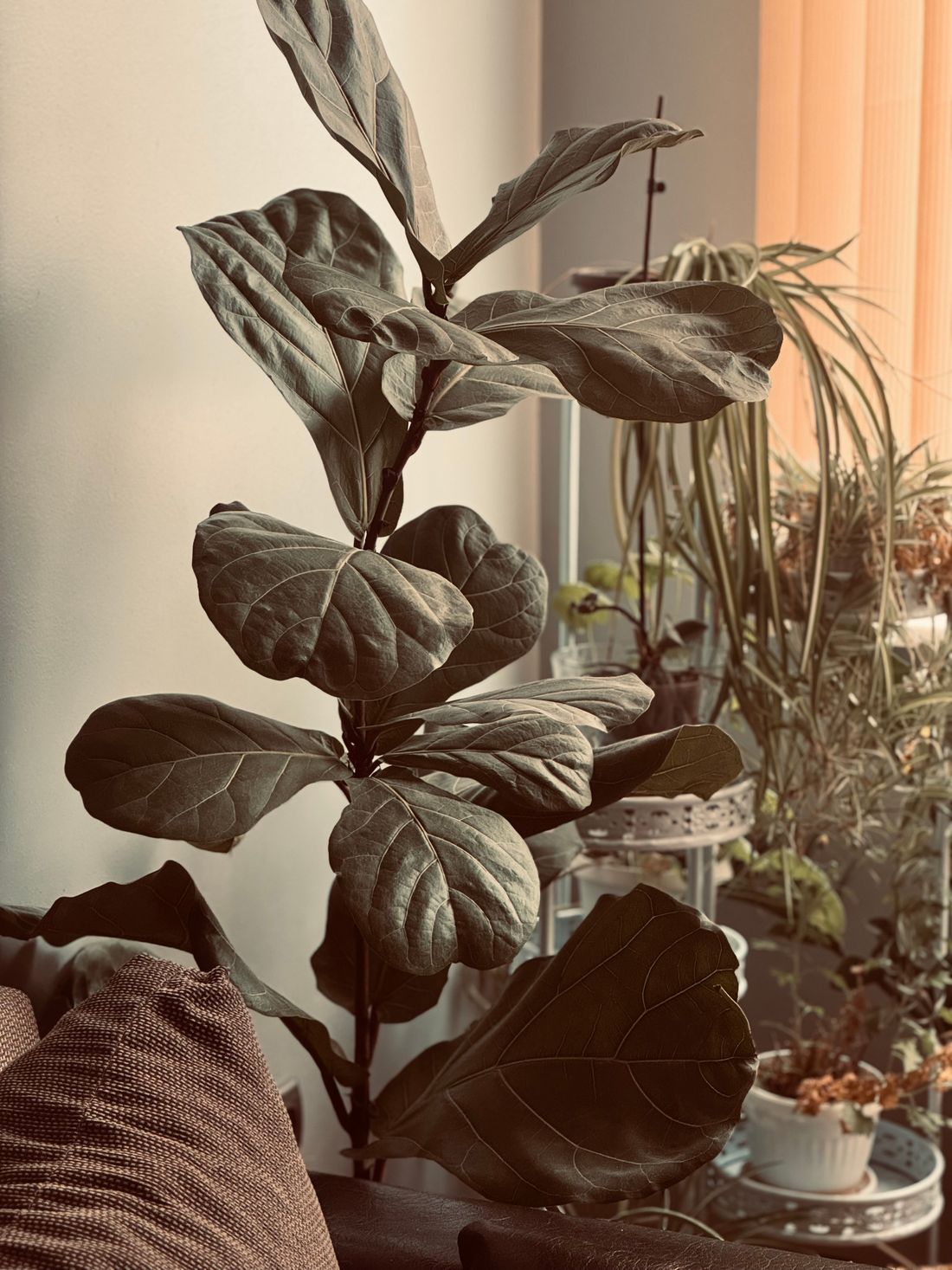
The best spot at this window is a flagged 65
Before our own scoring says anything: we gathered every published figure we could find for a fiddle leaf fig. 7 of them, from 5 separate sources, in 2 different units. They are reproduced below exactly as each source writes them, and nothing here is converted.
| Who publishes it | What it says a fiddle leaf fig needs | What the figure is |
|---|---|---|
| theplantrunner.com | 1,500–5,000 lux | Light-hungry aroids & Ficus divas (Fiddle Leaf Fig, variegated Monstera) |
| houseplantjournal.com | at least 400 foot-candles | Fiddle leaf fig — leaf-drop threshold |
| bbg.org | under 250 foot-candles | Fiddle-Leaf Fig (Ficus lyrata) |
| bbg.org | 2,000 to 6,000 foot-candles | Fiddle-Leaf Fig (Ficus lyrata) |
| extension.arizona.edu | 75–150 foot-candles | listed under the heading "Medium Light (75–150 fc)" |
| houseplantjournal.com | 400 FC (80 µmol) foot-candles | minimum indirect light level |
| houseplantsnook.com | 400–800 foot-candles | chart fc level |
Against the glass it scores 65 out of 100 and a metre back 64, with the light dimension flagged as dim at both. At two metres and at three, the light dimension fails outright and the verdict drops to not the best fit. There is no distance at this window where it comes back a good fit. That is unusual: most pairings in this series have at least one row that works.
| Distance from the glass | Estimated light | What the light is doing | Verdict |
|---|---|---|---|
| 0.3 m, against the glass | 3,640 lux | A little dim, but workable | Worth a try, 65/100 |
| 1 m back | 2,800 lux | A little dim, but workable | Worth a try, 64/100 |
| 2 m back | 1,764 lux | Too dim here | Not the best fit right now, 47/100 |
| 3 m back | 1,111 lux | Too dim here | Not the best fit right now, 46/100 |
Those light figures are estimates rather than meter readings, built from the window direction, the distance, and typical clear-day conditions. Two of the positions at the top of this page hedge on window size and obstruction, which is fair: those are real variables and a compass direction does not capture them. The free spot checker reads the spot you actually have, which is the only way that hedge gets resolved. Set the phone down where the pot would go.
Why “mine is doing fine” and “it will not cut it” are both being reported honestly
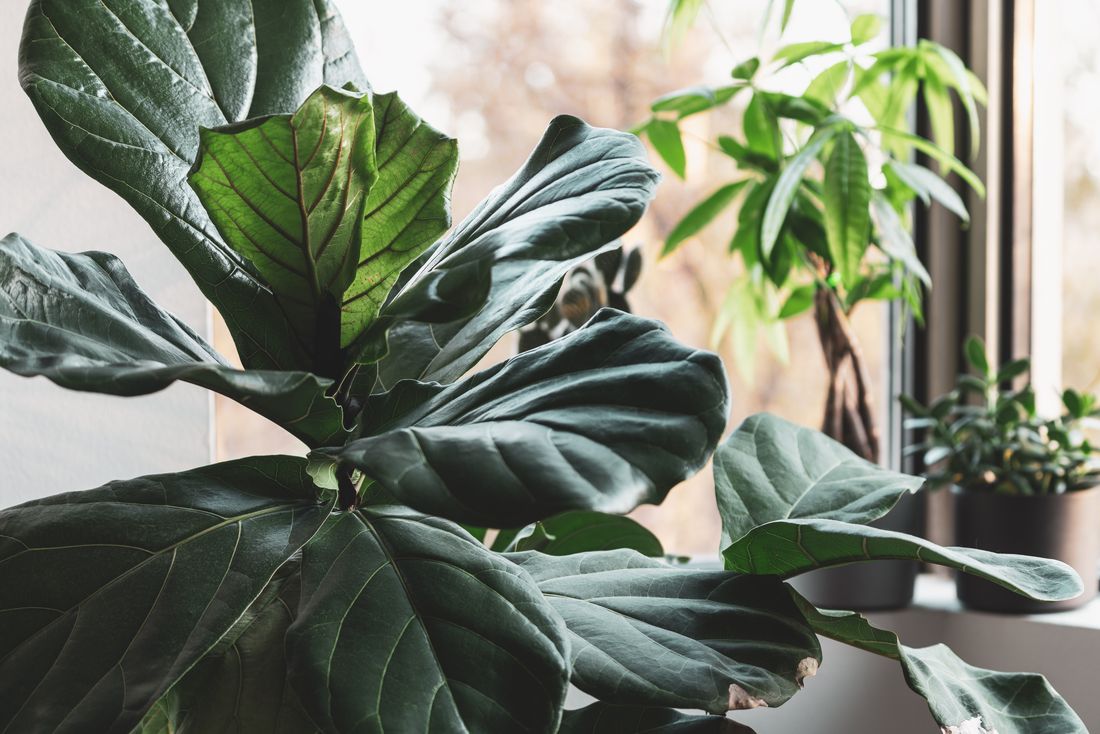
Look at the first two rows again. A flagged 65 is not a dead plant. It is a plant that will hold its leaves and grow slowly, and after two weeks of ownership it looks exactly like a plant that is doing fine, because it is. The gap between 65 and 100 does not show up as damage. It shows up as a year of very little happening, and by then almost nobody attributes it to where the pot went.
That is the whole reason both camps sound so sure. One camp is reporting the first month and the other is reporting the second year, and neither of them has a number to hand the other.
The same plant, one wall away
Move the identical plant to a south window, keep the air the same, and the table changes completely: a full hundred against the glass and at one metre, still a great fit at two, and worth a try at three. That page has the full table.
Running the same sill round the other three walls makes the point sharper still:
| The window it is sitting in | Estimated light | Verdict |
|---|---|---|
| North window | 3,640 lux | Worth a try, 65/100 |
| East window | 6,500 lux | Great fit, 98/100 |
| West window | 7,800 lux | Great fit, 99/100 |
| South window | 13,000 lux | Great fit, 100/100 |
Three of the four windows are a full score and the fourth is the one this page is about. The north sill is not a hard spot for this plant, it is the only hard spot.
So the honest framing of this pairing is not that a fiddle leaf fig is difficult. It is that this plant asks for more light than a north window has, and the fix is a different window rather than a different distance. Walking it closer to the glass buys you the difference between 46 and 65. Walking it to the other side of the flat buys you the difference between 46 and 100.
The clearest thing on this page
Take the same north window and put a monstera in it. The light readings are identical, row for row: 3,640 lux at the glass, 2,800 at a metre, 1,764 at two, 1,111 at three. Same window, same numbers going in. The monstera scores 99 out of 100 at the glass and 98 a metre in, where the fiddle leaf fig scores 65 with a flag on it.
Nothing about the spot changed. The reading is the same reading. The two plants simply want different amounts of it, and that is why no list of north-window plants and no rule about distance can answer the question on its own. Which plants suit a north window is a genuinely useful list; it is just not the same question as whether your plant suits your window.
If the north window is the only window
Three honest options, in the order we would try them.
- Put it in the window, not near it. The first metre is worth 20 points over the back of the room. That is the largest free improvement available here, and it costs nothing but floor space.
- Add light rather than subtract distance. A flagged light dimension is the one problem a grow light fixes directly. This is the pairing where that suggestion is not a cop-out.
- Choose a different plant for the spot and a different spot for this plant. Unsatisfying, and usually right. A north window is a good window for plenty of things; this is not one of them.
What we would not suggest is buying the plant anyway and hoping the window is one of the exceptional ones. If you want to know whether yours is, measure it rather than reason about it: how far a plant can live from a window covers what changes across the four directions, and the measurement takes about a minute.
What the slow version of this failure looks like
- New leaves come in smaller. Compare the newest leaf to one from a year ago. On this plant that comparison is unusually readable, because the leaves are large enough that a 20% difference is obvious once you hold them side by side.
- Longer bare stem between leaves. The plant stretches toward the window and puts more stem between fewer leaves. That spacing is a light reading.
- Lower leaves drop and are not replaced. A plant that sheds from the bottom while the top keeps going is triaging a light budget that no longer covers all of it.
- Nothing at all for a season. The most common outcome at a flagged 65 is not damage, it is stasis, and stasis is easy to read as a plant that is simply slow.
The room is not the spot
We put a phone down in six places in one bright living room, all six inside the same hour:
| Spot | Reading |
|---|---|
| At the bright window | 20,000 lux |
| 1 m from the window | 15,000 lux |
| 2–3 m away, in window shade | 3,500 lux |
| Middle of the room | 570 lux |
| Darker side of the room | 119 lux |
| The dark corner | 18 lux |
That room’s orientation was never recorded, so those are not north-window figures and we are not presenting them as any. What they show is the range a single room can hold, and why a plant with a high light requirement runs out of options so quickly indoors. The six readings are here.
By GrowSpot · Published August 12, 2026 · Last updated August 30, 2026
