You hit this question from one of two directions. Either you brought a plant home and the label says bright, indirect, east-facing preferred, or you found a guide that organises everything by window direction and realised you do not actually know yours. Renters hit it hardest: nobody memorises the compass orientation of a flat they viewed once, at speed, at an hour the sun was not doing anything memorable.
Answer the question below and you have it.
Find your direction
When does direct sun actually land inside this window?
If you have not watched the window across a day yet, one clear day is enough. Note roughly when sun lands inside, not just on the glass.
| When direct sun lands inside | Northern hemisphere | Southern hemisphere |
|---|---|---|
| Morning only, then it moves off | East | East |
| Through the middle of the day, strong and high | South | North |
| Late afternoon and evening, low and warm | West | West |
| Never, though the window can still be bright | North | South |
Why the sun answers it, and two backups
The reason the direction matters at all is that published guidance sorts by it before anything else, and attaches a different distance to each wall.
| Published by | What it attaches to the direction | In its own words |
|---|---|---|
| extension.illinois.edu | Low light | “North window: a few feet away”; “East/West window: 3-10 feet away”; “South window:15-20 feet away”. |
| extension.illinois.edu | Medium light | “North window: directly in front”; “East/west window: a few feet away”; “South window: 3-10 feet away”. |
| extension.illinois.edu | High and direct | “East/west window: directly in front”; “South window: up to 5 feet away”; and for direct light, “South window: directly in front”. |
| extension.arizona.edu | High light | “areas within four feet of large south-east or west facing windows.” |
| extension.arizona.edu | Medium light | “locations in a range of four to eight feet from south and east windows and west windows that do not receive direct sun.” |
| extension.msstate.edu | Beyond that | “It is difficult to grow plants in dimly lit areas more than 8 or 10 feet from windows.” |
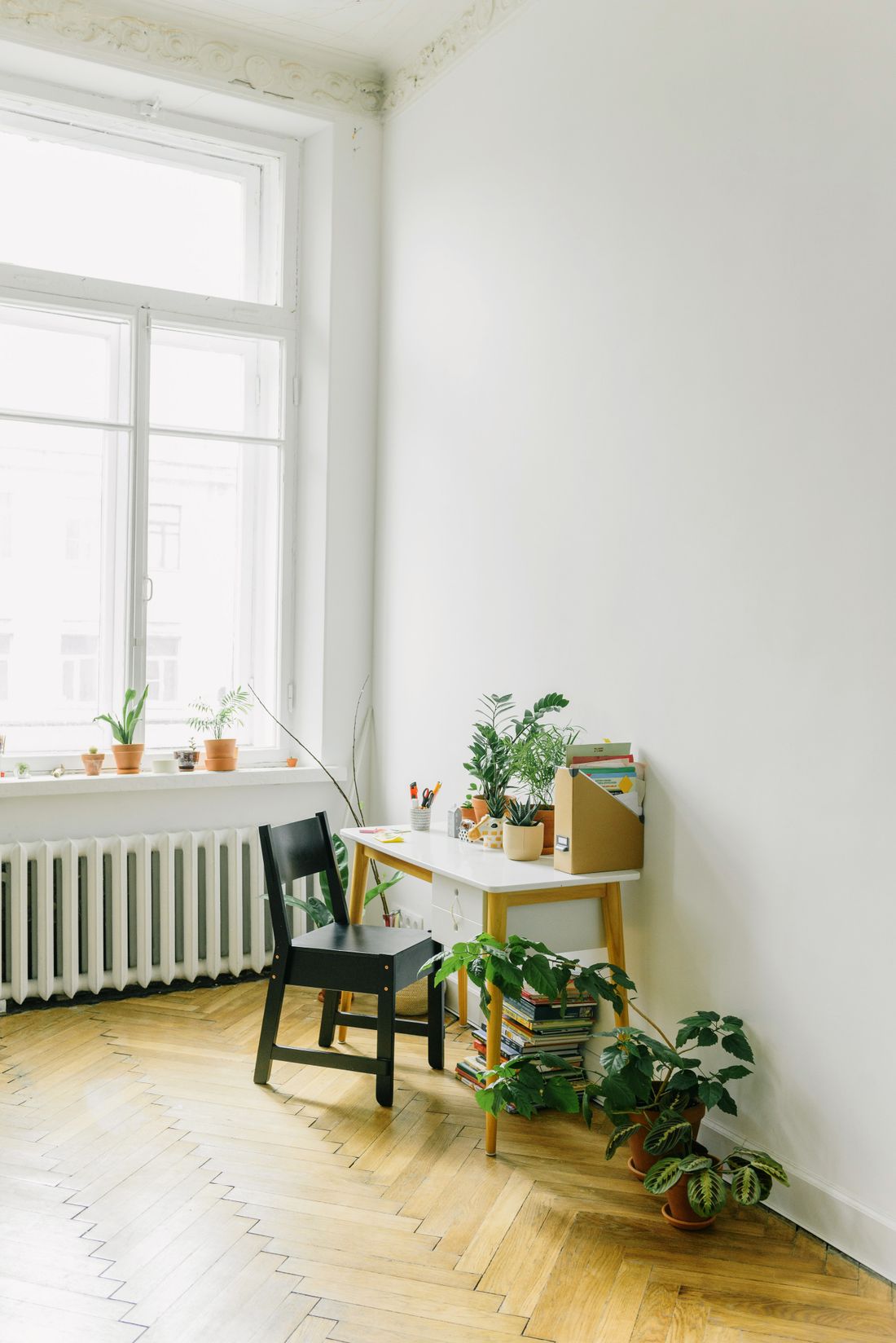
The sun rises in the east everywhere on Earth, crosses the sky on the equator side of your home, and sets in the west. That single fact turns your window into its own instrument. Morning sun inside means the window looks east. Sun through the middle of the day means it looks toward the equator: south if you live in the northern hemisphere, north if you live in the southern. Low evening sun means west. Bright all day with no direct sun ever entering means the window looks away from the equator, or something outside is blocking the sun before it arrives.
Two backups if you want to cross-check. Your phone has a compass app: stand at the window, face the glass squarely, and read the bearing it shows. And any street map does it too. Find your building, work out which edge of it your window sits on, and remember that map north is the top of the screen. The sun method still earns its place as the first answer, because it reports what the window actually receives rather than what geometry says it should.
What each direction is worth, in numbers
Direction matters because the light differs more than most people expect. These are our estimates under typical clear conditions in the northern hemisphere, from the same model that runs the free spot checker: first what a spot right against the glass gets from each thing a window can be doing, then the same four directions again as the pot moves back into the room.
| What that window gives the spot | Estimated light | What the light is doing | Verdict |
|---|---|---|---|
| No direct sun at all | 650 lux | A little dim, but workable | Worth a try, 63/100 |
| North window | 3,640 lux | Just the right amount of light | Great fit, 100/100 |
| East window | 6,500 lux | Just the right amount of light | Great fit, 100/100 |
| West window | 7,800 lux | Just the right amount of light | Great fit, 100/100 |
| Unshaded all day | 10,400 lux | Just the right amount of light | Great fit, 98/100 |
| South window | 13,000 lux | A bit bright, but workable | Worth a try, 67/100 |
| Distance from the glass | North window | East window | South window | West window |
|---|---|---|---|---|
| Right against the glass (0.3 m) | 3,640 lux | 6,500 lux | 13,000 lux | 7,800 lux |
| About 1.5 m back | 2,222 lux | 3,969 lux | 7,937 lux | 4,762 lux |
| About 3 m back | 1,111 lux | 1,984 lux | 3,969 lux | 2,381 lux |
Read it across and the south column carries roughly three and a half times the light of the north column at every distance. Read it down and every direction loses about two thirds of its light by three metres in. Both slopes matter: which window you choose, and how far from it the pot stands, move the number by similar amounts.
What to do with your answer
Each direction has its own guide on this site, with the plants that suit it and the ones that only pretend to:
- North-facing window plants: the gentle window. The whole low-light group lives here happily.
- East-facing window plants: morning sun, soft afternoons, the widest range of comfortable pairings.
- South-facing window plants: the most light in the house, and the one direction where too much is a real possibility.
- West-facing window plants: bright, with a hot late-day peak that some leaves resent.
Knowing the direction is not the finish line
Here is the trap waiting right after the victory. You work out the window faces south, remember that south means the most light, and give the brightest sill to the favourite plant. For a genuine sun lover that is exactly right. For the big middle group of foliage plants it can overshoot: here is a monstera placed right against south-facing glass, where the estimate runs to 13,000 lux.
That figure is modelled from the direction and typical clear conditions rather than read at your sill, and the measured counterpart is published openly: 204 readings at 104 spots, aggregates only, under CC BY.

Worth a try
It can work here with a little care.
A bit bright, but workable
Comfortable temperature
Humidity suits it
Airflow suits it
Temperature, humidity and air all suit it. The one flagged dimension is the one the direction decided, and the flag points the unexpected way: not too little light, too much for a plant that grew up under a rainforest canopy. A metre or two back from that same window and the pairing relaxes. The direction tells you which trade-offs your window offers; it does not yet say where in the room the pot should stand.
If you live in the southern hemisphere
Everything above holds with north and south swapped. Your midday sun sits in the northern sky, so the north-facing window is your bright one and the south-facing window is your gentle one. The tool at the top has a toggle for this, and the east and west columns behave the same on both sides of the equator.
When the compass and the light disagree
A window can face south by every map ever printed and still receive north-window light. Three things do it:
- A building opposite. It takes the sun out for part of the day or all of it, and the window behaves like one facing the other way.
- A balcony roof or overhang above. It intercepts the sun while the sun is high, so the middle of the day is what you lose.
- A mature tree. It blocks in leaf and lets the light through bare, so the same window is two different windows across the year.
When any of that is happening, trust the light. The plant has no idea what the compass says; it lives on what actually arrives. That is also the honest limit of this page: direction gets you the right starting shortlist, and the checker exists because real windows come with real obstructions.
About this page
The lux figures are estimates, not meter readings. They come from window direction and distance under typical clear conditions, produced by the same model that runs in the GrowSpot app and the free spot checker on this site, with the caveats that implies: an overcast climate, tinted glass or an obstruction will land you below them.
The worked example is a real engine result. The monstera card above was scored by the same engine the app uses, with temperature, humidity and airflow held at the plant’s own preferred values so the direction’s contribution stands alone. Where a figure on this page is an estimate we have said so.
By GrowSpot · Published August 6, 2026 · Last updated August 30, 2026
