A golden pothos pressed against a south window scores 45 out of 100, and the reason our scoring gives is the light: 13,000 lux, too bright. Pull the pot back a metre and it rises to 63, then only to 68 at two metres. Then, somewhere between two metres and two and a half, it jumps to 99. At five metres it’s still 100.
Read on 14 October 2026, the top results put a pothos everywhere from the glass to the far side of the room. A Reddit poster and a Facebook group member keep pothos right in a south window, the second one since 2016, and a commenter in another group asks why not put it in front of the glass. A garden forum reply calls a couple of feet from a sunny south-west window far enough. Joy Us Garden wants at least five to eight feet from the glass, and Simplify Plants says eight to nine. Plant Addicts sends you to an east window instead.

Great fit
This plant should be happy in this spot.
Just the right amount of light
Comfortable temperature
Humidity suits it
Airflow suits it
Most of that is advice about burn, and between them the answers cover nine feet of floor. Scored by distance, the line for a golden pothos sits at about eight feet. Only the farthest advice reaches it, and nothing behind it gets too dim for this plant within five metres.
How far from a south window should a pothos be?
For a golden pothos, two and a half metres, a little over eight feet. That’s further back than most of the search results go, and the published light figures for this plant don’t settle the question either. Here they are as published, units and all, with nothing converted:
| Who publishes it | What it says a pothos needs | What the figure is |
|---|---|---|
| theplantrunner.com | 800–2,000+ lux | Standard foliage plants (pothos, Philodendron, Monstera deliciosa …) — a general band, not a single-species figure |
| houseplantjournal.com | 100 foot-candles | Pothos — minimum indirect light |
| houseplantjournal.com | 200 foot-candles | Pothos — good indirect light |
| growlightmeter.com | 5 – 10 PPFD / DLI | Pothos |
| extension.arizona.edu | 25–75 foot-candles | listed under the heading "Low Light (25–75 fc)" |
| houseplantsnook.com | 50–100 foot-candles | chart fc level |
Not one of those is a distance, and a distance is what people are asking for. The figures describe the plant and leave the window out. The next table does the reverse: it keeps one plant and one window and moves the pot, with 22 °C, 50% humidity and medium airflow on every row, so the only thing that changes is how much light reaches it.
| Distance from the glass | Estimated light | What the light is doing | Verdict |
|---|---|---|---|
| 0.3 m, against the glass | 13,000 lux | Too bright here | Not the best fit right now, 45/100 |
| 1 m back | 10,000 lux | A bit bright, but workable | Worth a try, 63/100 |
| 1.5 m back | 7,937 lux | A bit bright, but workable | Worth a try, 65/100 |
| 2 m back | 6,300 lux | A bit bright, but workable | Worth a try, 68/100 |
| 2.5 m back | 5,000 lux | Just the right amount of light | Great fit, 99/100 |
| 5 m back | 1,575 lux | Just the right amount of light | Great fit, 100/100 |
Between the 2 m and 2.5 m rows the estimate falls to 5,000 lux from 6,300 and the score climbs from 68 to 99. In front of that line the plant is coping with more light than it wants. Temperature, humidity and airflow sit inside their bands on every row, so none of the lost points come from anywhere else.
Lay the search results over the table and they sort themselves out. Right in the window is the 45 row. Five feet, where the Joy Us Garden range starts, is about 1.5 m and worth a try. Simplify Plants’ eight to nine feet is the one piece of advice that gets past the line.
We didn’t put a meter anywhere for those lux figures. Each one is an estimate built on the window’s compass bearing, the pot’s distance from it and a cloudless sky. Trust the table for where it changes more than for any single reading.
Why do some pothos do fine right in a south window?
Partly because the search results aren’t all talking about the same plant. The Reddit poster who keeps a pothos in a south window, with a few burn spots early on and fine since, grows an N’Joy. A commenter in the same thread says theirs hated that window and put out new leaves once it moved to a bathroom with a north window. They don’t say which pothos it was. Our care data files five of these six cultivars at the bright end, and one metre from the glass leaves the golden on its own:
| Cultivar | What our care data asks for | Verdict |
|---|---|---|
| Golden pothos | low, shade-friendly light | Worth a try, 63/100 |
| Neon pothos | bright, indirect light | Great fit, 99/100 |
| Pothos N’Joy | bright, indirect light | Great fit, 99/100 |
| Marble Queen pothos | bright, indirect light | Great fit, 99/100 |
| Manjula pothos | bright, indirect light | Great fit, 99/100 |
| Snow Queen pothos | bright, indirect light | Great fit, 99/100 |
The other five score 99 at one metre. A golden scores 63 at the same spot and needs another metre and a half. So the growers keeping pothos close to south glass and the sites asking for eight feet may each be right about the plant in front of them. One shop sells golden and Marble Queen pothos in its south-light collection, with a note that some plants burn in direct south light and grow lush behind a filter. Of those two, only the golden needs the extra room here; a Marble Queen is a great fit from 0.9 m.
Three metres from an east window the split runs the other way, with the bright-end five losing points, and the east window page has that cultivar table.
Is a south window worse for a pothos in summer?
On light, it is the reverse. The Reddit commenter who expects a south-window pothos to burn by June is picturing the high summer sun. Through vertical south glass that sun lands close to the sill, while the low winter sun reaches much further into the room.
Dated at latitude 40, our scores bear that out. Light through south glass, facing the window, is lowest in June and highest in February and October. The 2.5 m spot from the card reads a bit bright from 31 January to 15 March and from 28 September to 10 November, three metres back is a great fit every day of the year, and from 19 April to 24 August even two metres back is one. So the seasons to give a golden pothos more room are late winter and autumn, not summer.
What does bright indirect light mean at a south window?
Plant Addicts says pothos prefer bright indirect light. At a south window that phrase covers a lot of floor. The estimates for the 1.5 m, 2 m and 2.5 m rows all fall in the band the app’s light meter labels bright, indirect, and that band holds two worth-a-try spots and the first great fit. The 1 m row sits right on the meter’s line into its top band.
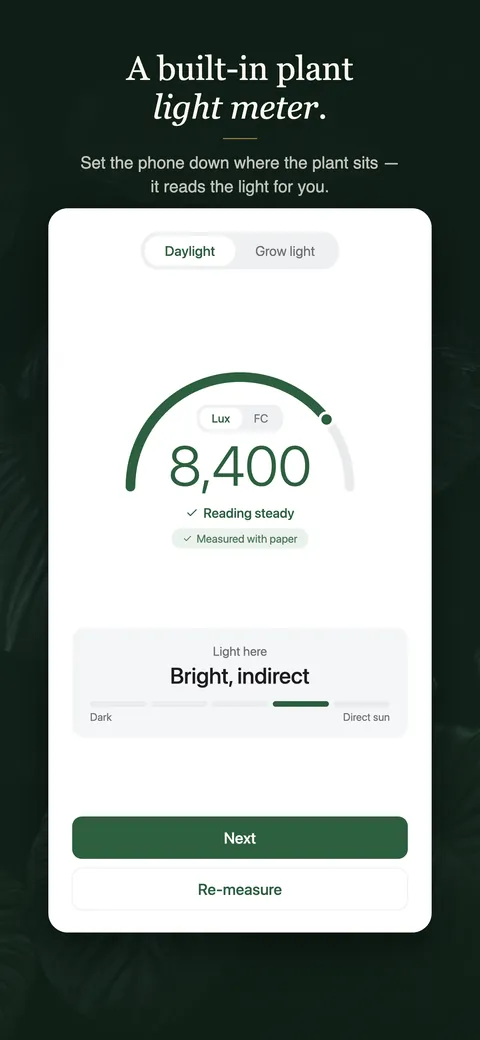
A reading of bright, indirect puts you somewhere in that stretch. Which side of the line you’re on is the part the distance table answers.
Which window suits a pothos best?
Any of them, and the brighter the window, the further back the good spot starts. A north sill already counts as a great fit on the pothos light page, which also sets out the band in lux. At an east window the great fit begins within a metre of the glass, at a west window within two, and at a south one about two and a half metres back. At a north window there is no step to find, and the cold glass is the only reason to move it. A prayer plant at this same glass clears its flag sooner, at about a metre and a half, and a hoya is a great fit right on the sill. A heartleaf philodendron at a south window walks back through the same scores row for row, and so does a parlor palm, so a south room treats all three as one plant.
What changes these numbers in a real south room?
Everything above assumes an open south window and a clear day. An overhang, a tree, the next building or a sheer curtain each takes light away, and in a south room that pulls the line toward the glass. How far it moves depends on how much each one blocks, which no estimate here can know. The south window guide covers the plants that want the full beam and the ones that scorch in it. To put a number on your own shelf, try the free spot checker with today’s local weather.
Published October 14, 2026 · Last updated November 8, 2026
