Search this pairing and you get four confident, incompatible answers. Keep it at least eight to ten feet from a west window, says one care guide. An east or west window is where you want it, says a large plant retailer. Near a west window, says a gardening site that otherwise recommends five to ten feet of distance from a south one. Behind sheer curtains, says a fourth, because a west window carries a risk similar to a south one. Meanwhile the most-read thread on the subject is someone asking whether a west window is too bright for a pothos at all.
Those answers span roughly three metres of floor. We scored the plant at four points across that span, changing nothing but the distance, and the reason the advice disagrees became clear: on this pairing there is nothing to disagree about.

Great fit
This plant should be happy in this spot.
Just the right amount of light
Comfortable temperature
Humidity suits it
Airflow suits it
Four distances, one verdict
Before our own scoring says anything: we gathered every published figure we could find for a golden pothos. 6 of them, from 5 separate sources, in 3 different units. They are reproduced below exactly as each source writes them, and nothing here is converted.
| Who publishes it | What it says a golden pothos needs | What the figure is |
|---|---|---|
| theplantrunner.com | 800–2,000+ lux | Standard foliage plants (pothos, Philodendron, Monstera deliciosa …) — a general band, not a single-species figure |
| houseplantjournal.com | 100 foot-candles | Pothos — minimum indirect light |
| houseplantjournal.com | 200 foot-candles | Pothos — good indirect light |
| growlightmeter.com | 5 – 10 PPFD / DLI | Pothos |
| extension.arizona.edu | 25–75 foot-candles | listed under the heading "Low Light (25–75 fc)" |
| houseplantsnook.com | 50–100 foot-candles | chart fc level |
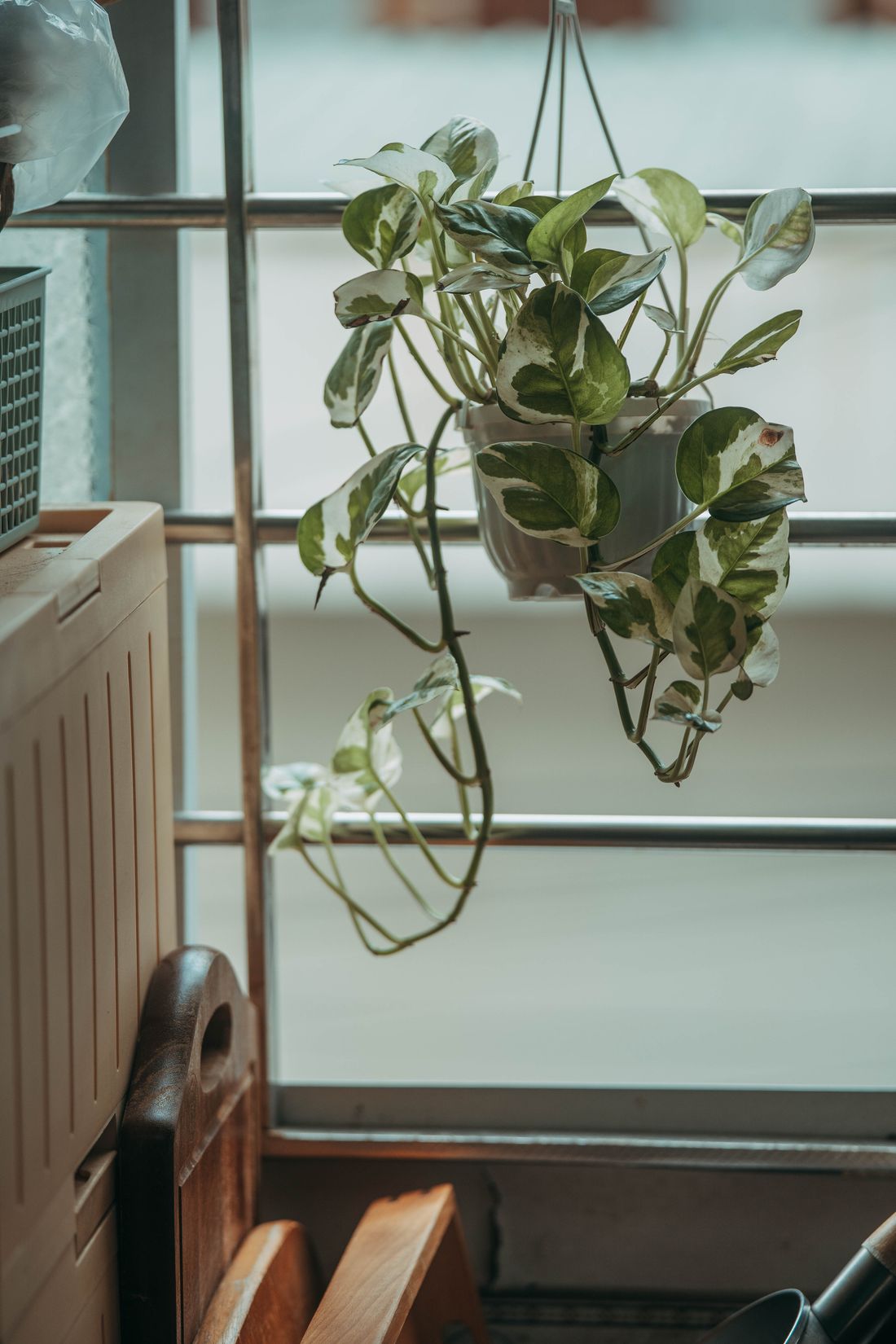
Against the glass, one metre back, two metres back and three metres back, a golden pothos at a west window is workable everywhere and best away from the glass. Nearest the window the light runs a little bright and the verdict is worth a try; from two metres back it sits square in band and becomes a great fit. The eight-to-ten-feet camp and the put-it-in-the-window camp are both describing spots that work.
| Distance from the glass | Estimated light | What the light is doing | Verdict |
|---|---|---|---|
| 0.3 m, against the glass | 7,800 lux | A bit bright, but workable | Worth a try, 66/100 |
| 1 m back | 6,000 lux | A bit bright, but workable | Worth a try, 68/100 |
| 2 m back | 3,780 lux | Just the right amount of light | Great fit, 100/100 |
| 3 m back | 2,381 lux | Just the right amount of light | Great fit, 100/100 |
Those light figures are estimates rather than meter readings, built from the window direction, the distance, and typical clear-day conditions. Your window is not a typical one, so if the answer matters to you, the free spot checker will read your actual spot: put the phone down where the pot would go.
A table where every row works is not a boring result. It is the one shape that tells you to stop optimising and go do something else, and almost nothing published on this pairing will tell you that, because “it does not matter” is a hard thing to build an article around.
Then what are people actually arguing about?
Two different worries wearing the same clothes.
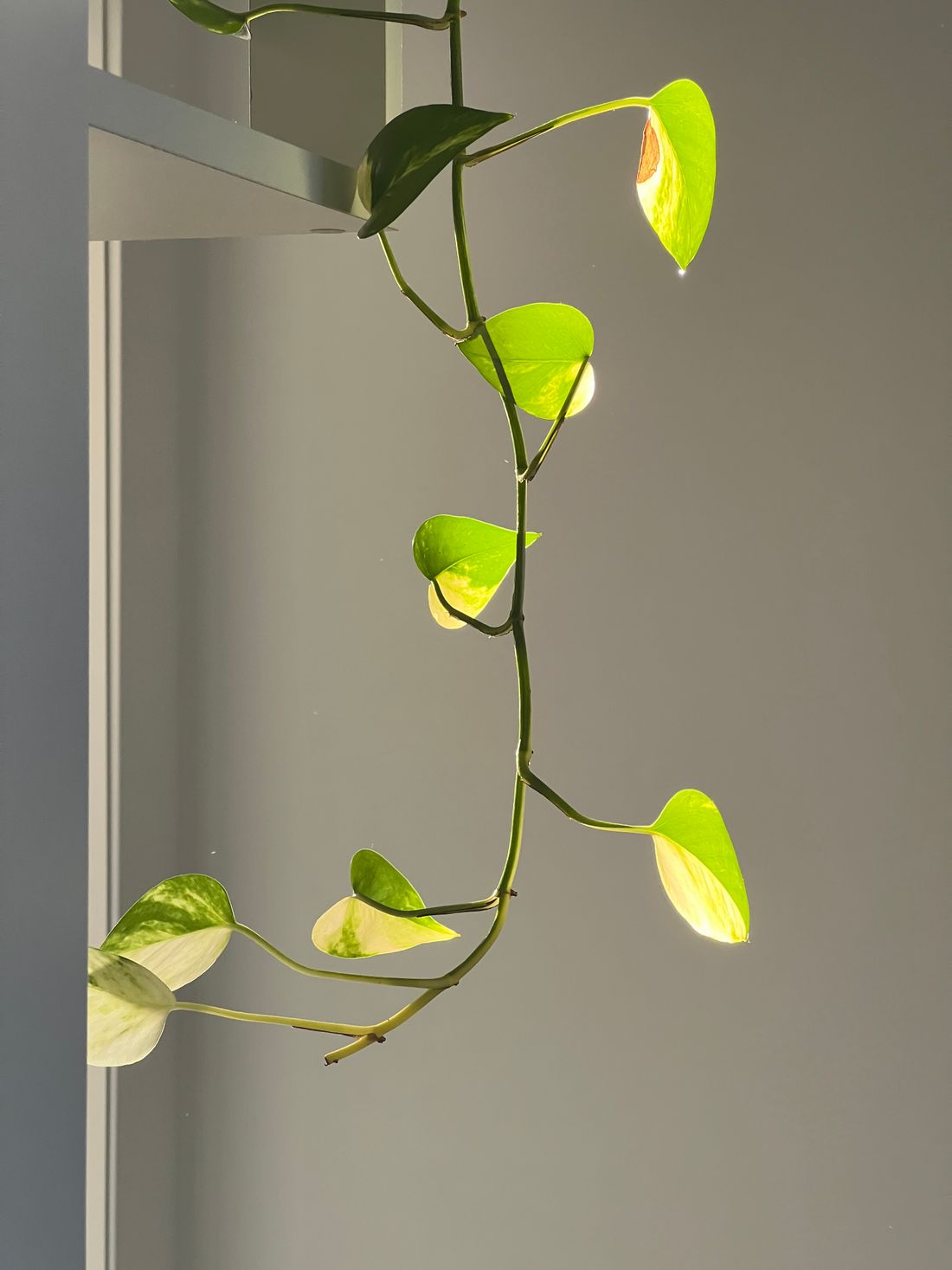
The first is scorch. A west window delivers its light in the afternoon, when the air behind the glass is at its hottest, and leaves pressed against hot glass can mark. That is a real thing and this table does not disprove it. What the table shows is that it is not a light problem, which means moving the plant backwards is not the fix people think it is. Our worked example sits at 22 °C. On a genuinely hot afternoon the dimension that moves is temperature, and it moves whether the pot is at the sill or two metres in.
The second is the opposite fear, that a spot several feet into the room is too dim. For this plant, at this window, within this span, it is not. That is what the fourth row is for.
Both worries are legitimate and neither is answered by a number of feet. They are answered by looking at the spot you actually have, on the kind of day that actually worries you.
The same window, a plant with far less room
Put a burgundy rubber plant at the identical four spots and the table stops being flat:
| Distance from the glass | Golden pothos | Burgundy rubber plant |
|---|---|---|
| 0.3 m against the glass7,800 lux | 66/100 | 93/100 |
| 1 m back6,000 lux | 68/100 | 92/100 |
| 2 m back3,780 lux | 100/100 | 63/100 |
| 3 m back2,381 lux | 100/100 | 61/100 |
The pothos column climbs to a great fit and stays there. The rubber plant column falls off a step between one metre and two, and by three metres the two plants have traded places in the same window. The rubber plant has its own page for this window, where it reads a shade better still, because that page holds the air a little gentler than this one does. The two pages together are the point of scoring a plant and a spot as a pair.
Both plants are on every list of things that do well in a west window. Both entries are true. One of them has three metres of room and the other has about one, and the list cannot tell you that because the list is a fact about the window and your problem is a fact about the corner. What else works in a west window is still worth reading; it just answers a different question than the one you came with.
Where this plant does run out of room
The distance table above is specific to a west window. Move the same plant to an east one and the fourth row changes: at three metres from an east window it is workable rather than a good fit, with the light dimension flagged. The east version of this page has that table.
Distance is not the only dial, either. Hold the three-metre spot still and move the thermometer instead: 100 out of 100 at 21 °C and 99 at 27, but 66 at 30, 64 at 16, and not a fit at all at 33 or at 10.
So the distance table above is a mild-day table. A west-facing room that shuts up all afternoon in August is a different spot from the same room in April, and that is the axis this plant is actually sensitive to.
This window runs about a fifth brighter than an east one at every distance, which is enough to matter at the far end of the room and not enough to matter anywhere else. A north window is a different conversation again, and a windowless room is a conversation about grow lights.
What a pothos looks like when the light really is wrong
Since distance is not your lever here, it is worth knowing what would actually be worth reacting to.
- Long bare vine between leaves. This is the classic under-lit pothos, and the spacing is readable without any instrument. Leggy growth is a light reading.
- Variegation fading to plain green. The pale parts of a golden pothos leaf do less work, so in dim conditions the plant favours green tissue. New leaves coming in flatter and greener than the old ones is the signal.
- Bleached or papery patches on leaves that face the glass. This one runs the other way. It is the scorch worry made visible, and it is a reason to filter the light or move the pot off the sill rather than to relocate it across the room.
- Nothing happening at all. A pothos that has not put out a new leaf in months is telling you something, though the something is as often water or root space as it is light.
The room is not the spot
We put a phone down in six places in one bright living room, all six inside the same hour. Which of the six a pothos calls ideal, in lux, is on the pothos light page:
| Spot | Reading |
|---|---|
| At the bright window | 20,000 lux |
| 1 m from the window | 15,000 lux |
| 2–3 m away, in window shade | 3,500 lux |
| Middle of the room | 570 lux |
| Darker side of the room | 119 lux |
| The dark corner | 18 lux |
That room’s orientation was never recorded, so those are not west-window figures and we are not presenting them as any. What they show is how much range a single room holds, and why a plant that tolerates the whole first three metres of it is genuinely easy to place while a fussier one is not. The six readings are here, and how far from a window plants can live takes the question across the other directions.
By GrowSpot · Published August 12, 2026 · Last updated August 30, 2026
