Scored for a Burgundy rubber tree at 22 °C and 50% humidity, a west sill at 7,800 lux comes back 99 out of 100 and one metre back 98; two metres back it drops to 65 and three metres to 63, with the light flagged as dim at both. The plant gets about one metre of room.
The advice on this pairing does not merely lack numbers. It disagrees with itself. One care site calls a west window the next best location after a south one. Another says to keep the plant several feet back from a west or south window. A third says to hang a sheer curtain over it. The most upvoted answer in a plant group says a west window will be your best bet, because rubber trees love sunlight. All four are describing the same window and the same plant, and none of them says how far.
So we scored it. Same plant, same west window, four distances, nothing changing but the distance. The result is narrower than the enthusiasm and wider than the caution.

Worth a try
It can work here with a little care.
A little dim, but workable
Comfortable temperature
Humidity suits it
Airflow suits it
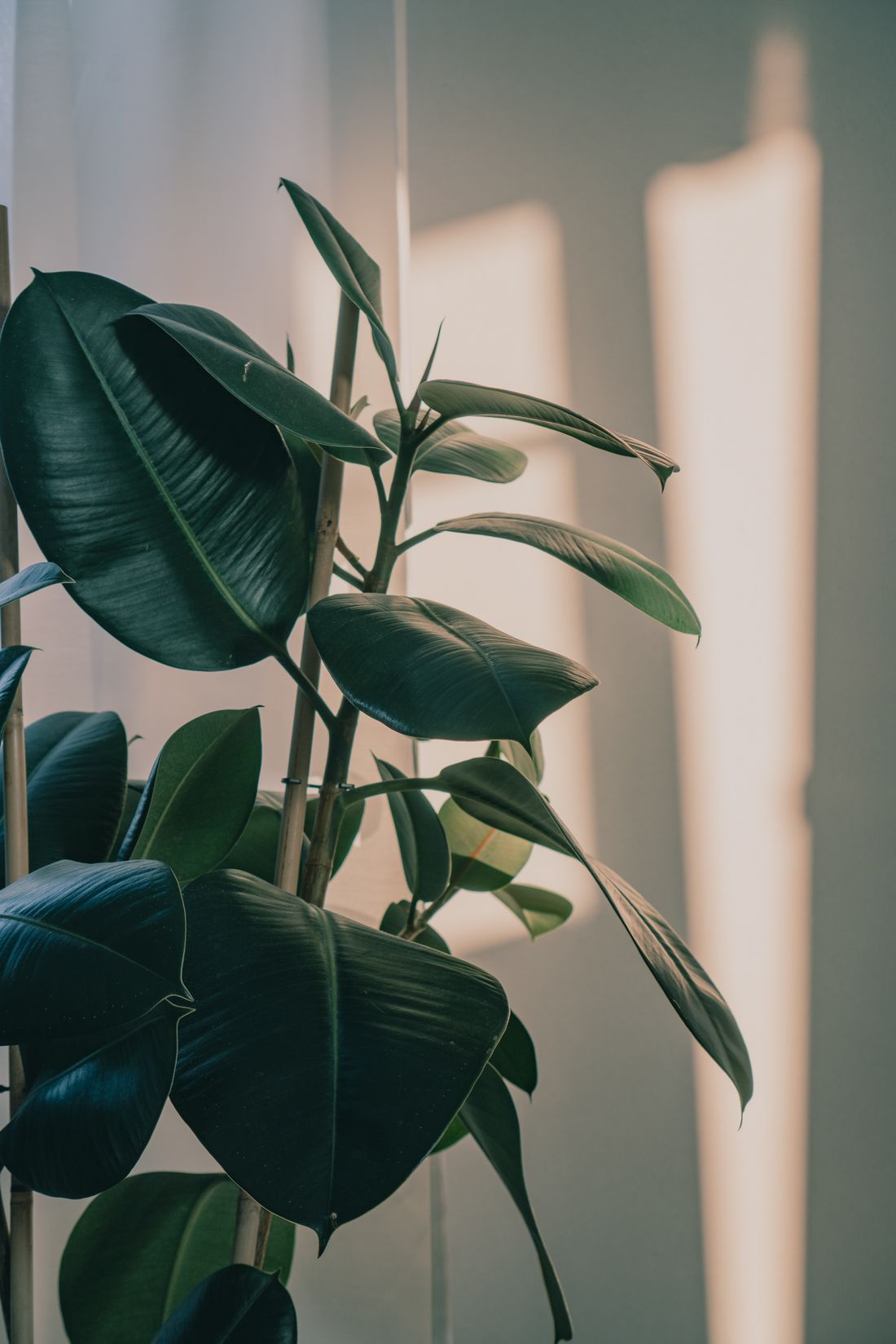
A metre, and then it starts to cost you
Before our own scoring says anything: we gathered every published figure we could find for a rubber plant. 7 of them, from 5 separate sources, in 2 different units. They are reproduced below exactly as each source writes them, and nothing here is converted.
| Who publishes it | What it says a rubber plant needs | What the figure is |
|---|---|---|
| theplantrunner.com | 800–2,000+ lux | Standard foliage plants (pothos, Philodendron, Monstera deliciosa …) — a general band, not a single-species figure |
| bbg.org | as little as 250 foot-candles | India Rubber Tree (Ficus elastica) |
| bbg.org | 4,000 to 8,000 foot-candles | India Rubber Tree (Ficus elastica) |
| extension.arizona.edu | 75–150 foot-candles | listed under the heading "Medium Light (75–150 fc)" |
| houseplantjournal.com | 400 FC (80 µmol) foot-candles | minimum indirect light level |
| houseplantjournal.com | 800 FC (160 µmol) foot-candles | good indirect light level |
| houseplantsnook.com | 200–400 foot-candles | chart fc level |
Against the glass and one metre back, this plant scores 99/100 and 98/100 with all four dimensions in band. At two metres the light dimension is flagged and the score falls by a third. At three metres it is still workable, but only just, and the light dimension is flagged the whole way.
That one metre is the finding. It sounds small until you compare it with the version of this page for an east window, where the same plant has already dropped to 67 by the time you are a metre back. Same plant, same four distances, same everything except which wall the window is in. The east window costs it that first metre; the west window does not.
| Distance from the glass | Estimated light | What the light is doing | Verdict |
|---|---|---|---|
| 0.3 m, against the glass | 7,800 lux | Just the right amount of light | Great fit, 99/100 |
| 1 m back | 6,000 lux | Just the right amount of light | Great fit, 98/100 |
| 2 m back | 3,780 lux | A little dim, but workable | Worth a try, 65/100 |
| 3 m back | 2,381 lux | A little dim, but workable | Worth a try, 63/100 |
Those light figures are estimates rather than meter readings, built from the window direction, the distance, and typical clear-day conditions. If you want the number for your own window instead of a typical one, the free spot checker will read it: set the phone down where the pot would go and let it measure.
The advice that our table disagrees with
Of the four positions above, the one worth arguing with is “several feet back.” Several feet is about two metres, and two metres is exactly where this plant drops out of the nineties. Someone who reads that sentence, measures it out honestly, and puts the pot on a stand at the far edge of the light has followed the instruction and landed on the flagged side of the band.
The instruction is not stupid. It is aimed at a real risk, which is the afternoon heat that a west window carries and an east one does not. But it treats a heat problem as a distance problem, and distance is not what fixes heat. Backing a high-light plant out of the light to protect it from warmth costs you the light and leaves the warmth roughly where it was.
What the scoring does and does not cover here
Our worked example puts the air at 22 °C, and at that temperature the spot against the glass is in band on all four dimensions. That is a mild-day answer. On a hot afternoon behind west-facing glass the air at the sill is not 22 °C, and the dimension that moves is temperature, not light. This is the honest boundary of a distance table: it tells you what the light does as you walk backwards, and it tells you nothing about what your particular July does to your particular sill.
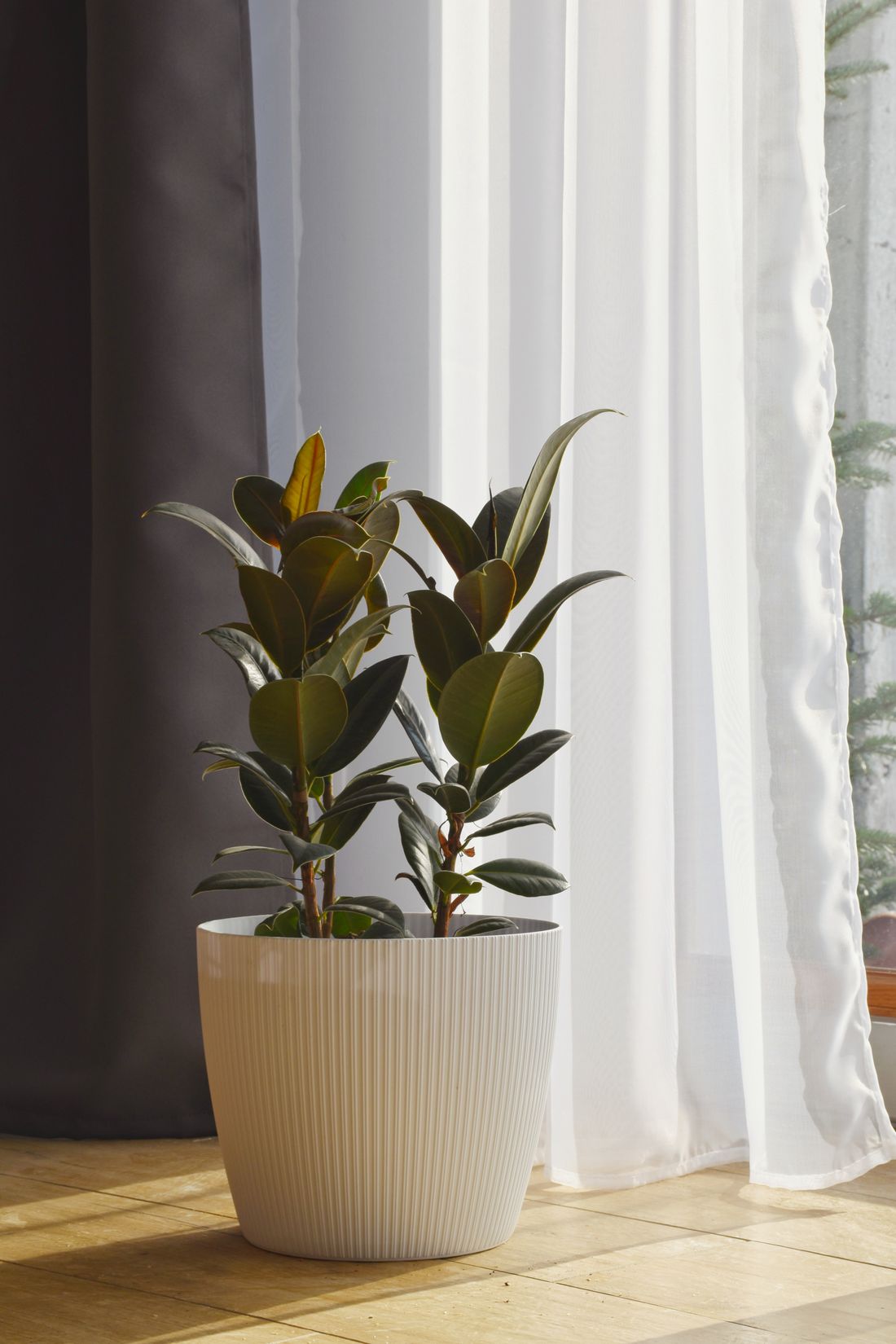
The other thing a distance table cannot show you is what the same distance is worth at a different wall. Two metres is where this page picks up its flag, so here is two metres, four times: not a fit at all from a north window, worth a try from an east one at 64 and from this west one at 65, and a great fit from a south one at 98.
Two metres is not a fact about a plant. It is a fact about a plant, a wall, and the direction that wall faces.
Why the same distance is not the same spot
A distance that changes its answer with the wall is the argument for measuring rather than reading. A west window in a cool climate with a deep overhang and a west window on the third floor of a hot city are the same compass direction and not the same spot. The west window guide covers which plants suit the direction; the distance and the day are yours.
The same window, a completely different answer
Put a golden pothos at the identical spots and the table runs the other way:
| Distance from the glass | Burgundy rubber plant | Golden pothos |
|---|---|---|
| 0.3 m against the glass7,800 lux | 99/100 | 64/100 |
| 1 m back6,000 lux | 98/100 | 66/100 |
| 2 m back3,780 lux | 65/100 | 94/100 |
| 3 m back2,381 lux | 63/100 | 94/100 |
One column falls twice and the other never moves. The pothos version of this page is here, and the pair of them is the whole argument for scoring a plant and a spot together rather than either one alone.
This is why “good for a west window” is not a useful sentence. Both plants are good for a west window. One of them has three metres of room and the other has one, and no list of west-window plants can tell you that, because the list is answering a question about the window and you are asking a question about the corner you have.
What too far back looks like on this plant
The failure is slow enough to be mistaken for the plant simply getting older.
- The gaps between leaves get longer. New growth arrives with more bare stem between leaves, so the plant reads as sparse rather than unwell. That spacing is a light reading you can take with your eyes.
- Burgundy varieties go green. The dark pigment is expensive to hold, and it is the first thing dropped when the light budget tightens. A plant that arrived deep maroon and is now plain green has usually been moved, or the light around it has changed.
- New leaves come out smaller than old ones. Compare the newest leaf against one from last year. That comparison is far more reliable than any judgement you can make about how bright a room looks.
- The lower leaves go first. The plant triages a light budget that no longer covers all of it, and the bottom of the plant is what it gives up.
Moving it, if it is currently too far back
The most common way to damage this plant is to get the diagnosis right and the speed wrong. A rubber plant that has spent a year three metres into the room, correctly identified as light-starved, gets carried to a west sill in one afternoon and marks its leaves within days. Those marks do not heal; this plant does not shed and replace foliage fast enough to grow out of the mistake.
Move it in stages instead, over two or three weeks, roughly half the remaining distance each time. Three metres back it is worth a try at 63, at a metre and a half still worth a try at 67, and at seventy centimetres a great fit at 99 — the same as at the glass.
The destination was never the problem. What the staging buys you is that no single step is a large jump, and the last two steps are the ones that pay: the plant is still flagged at a metre and a half and is not flagged at seventy centimetres.
The room is not the spot
We put a phone down in six places in one bright living room, all six inside the same hour:
| Spot | Reading |
|---|---|
| At the bright window | 20,000 lux |
| 1 m from the window | 15,000 lux |
| 2–3 m away, in window shade | 3,500 lux |
| Middle of the room | 570 lux |
| Darker side of the room | 119 lux |
| The dark corner | 18 lux |
That room’s orientation was never recorded, so those are not west-window figures and we are not presenting them as any. What carries over is the shape of the fall, and the shape is why a metre matters so much: most of the light in any room is gone within the first couple of metres, so the decisions that count are all made in a very small part of the floor. The six readings are here, and how far a plant can live from a window takes the same question across the other three directions.
By GrowSpot · Published August 12, 2026 · Last updated August 30, 2026
