A ZZ plant right against a south window scores 65 out of 100 at 22 °C and 50% humidity, and light is the reason: the 13,000 lux there reads a bit bright for it. Six feet back it scores 68. The jump comes between 2.1 and 2.2 metres, where the estimate falls from 6,015 to 5,743 lux and the score rises to 98.
Read on 14 October 2026, the top results mostly want a ZZ out of the direct south beam, and they disagree on the distance. Bouqs says off the sill and a few feet back. Ohio Tropics puts the ZZ on its south-window list, a few feet from unshaded glass. Low Light Leaf says four to six feet, or closer behind a sheer. Joy Us Garden wants at least six feet from any south or west window. Our House Plants sends it to another wall, and Blooming Expert says only to keep it back from the glass.
Nobody prints a figure for the light, and nobody starts further out than six feet. Six feet is where the distance table below is still flagging it.

Worth a try
It can work here with a little care.
A bit bright, but workable
Comfortable temperature
Humidity suits it
Airflow suits it
Can a ZZ plant sit in a south-facing window?
Here are the light figures published for a ZZ, each in its source’s own unit. The one row in lux tops out far below anything our estimate gives within four metres of south glass:
| Who publishes it | What it says a ZZ plant needs | What the figure is |
|---|---|---|
| theplantrunner.com | 300–800 lux | True low-light crew (ZZ, snake plant, cast-iron plant, some ferns) |
| growlightmeter.com | 5 – 10 PPFD / DLI | ZZ Plant |
| houseplantjournal.com | 100 FC (20 µmol) foot-candles | minimum indirect light level |
| houseplantjournal.com | 200 FC (40 µmol) foot-candles | good indirect light level |
| houseplantsnook.com | 50–100 foot-candles | chart fc level |
Yes. The card above gives the sill 65, worth a try, the app’s word for a spot that can work with a little care. Only the light is marked, a bit bright but workable; temperature, humidity and airflow sit inside their bands. That’s milder than anything in the search results, and no distance in the next table gets a harsher word. A golden pothos on the same sill does: too bright.
The 13,000 is an estimate for the whole spot on a clear day. A patch of unfiltered midday sun lying across one leaf runs brighter than that, and it’s the patch the burn warnings mean when Joy Us Garden says the plant burns in direct sun. The shadow test tells you in a second whether you have one. A crisp shadow on the leaves means the beam is landing on them, and that’s a reason to move the pot whatever the score says.
How far from a south window should a ZZ plant be?
A little over seven feet, if nothing shades the window. Here is one ZZ moved back through each distance in those results, then across the line:
| Distance from the glass | Estimated light | What the light is doing | Verdict |
|---|---|---|---|
| 0.3 m, against the glass | 13,000 lux | A bit bright, but workable | Worth a try, 65/100 |
| 0.9 m back | 10,473 lux | A bit bright, but workable | Worth a try, 66/100 |
| 1.2 m back | 9,117 lux | A bit bright, but workable | Worth a try, 67/100 |
| 1.8 m back | 6,910 lux | A bit bright, but workable | Worth a try, 68/100 |
| 2.1 m back | 6,015 lux | A bit bright, but workable | Worth a try, 68/100 |
| 2.2 m back | 5,743 lux | Just the right amount of light | Great fit, 98/100 |
| 4 m back | 2,500 lux | Just the right amount of light | Great fit, 99/100 |
The first five rows hardly move. From the sill to 2.1 metres the score creeps from 65 to 68, three points across nearly two metres of floor, with the light flagged on every row. Then the estimate slips from 6,015 to 5,743 lux and the score jumps to 98. Four metres back, about thirteen feet, it reads 99.
Now lay the advice on top. A few feet back is the 0.9 m row, at 66. Low Light Leaf’s four to six feet runs from the 1.2 m row to the 1.8 m one, and Joy Us Garden’s six feet is that last row, at 68. All of it sits in the flagged stretch. Six feet stops about a foot short of the line.
So the most cautious advice buys a ZZ three points over the sill. What changes the verdict is the foot after it. A bird’s nest snake plant at the same glass is also still flagged two metres back, and a hoya runs the other way, a great fit on the sill and out of light past about two metres. A beetle peperomia clears the flag about a metre in.
Is a south window worse for a ZZ plant than the others?
At six feet, yes: the other three windows have cleared the line by then. On an east window a ZZ comes clear about two feet from the glass, between the same two readings as the 2.1 and 2.2 m rows here, 6,015 and 5,743 lux. At a west window it takes about a metre, and north glass suits it right on the sill. The line is a light level. The compass only decides how deep into the room it falls. That’s why Joy Us Garden’s single figure for south and west windows lands so differently: past the line at west glass, about a foot short of it at south.
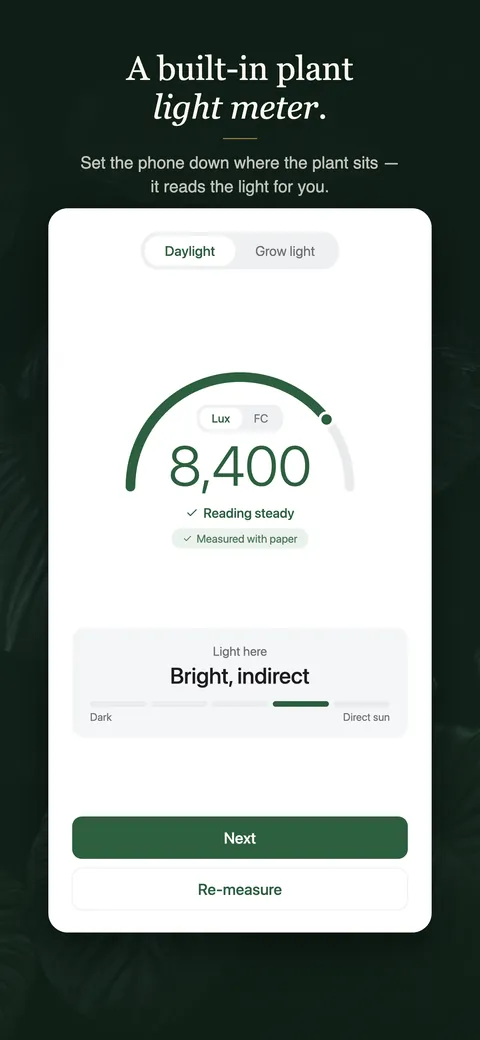
That reading is worth more than any row above, because the tables assume an open window on a clear day. An overhang, a balcony above, a tree or the next building will each pull the line toward the glass, by an amount no estimate here can know. Our lux figures come from the window direction, the distance and a clear sky, not from a meter, and a reading at the pot counts everything they leave out.
Does six feet back work for a ZZ plant in summer?
Yes, from mid-April to the end of August. The line above comes from a clear day with no date in it. Joy Us Garden, Hey Rooted and Low Light Leaf all tie the risk to summer, and for light through south glass our dated scores point the other way: at latitude 40, light reaching south glass, facing the window, peaks in February and October and is lowest in June. Here is the six-foot row, 1.8 metres back, on the 21st of eight months:
| The 21st of | Estimated light | What the light is doing | Verdict |
|---|---|---|---|
| January | 6,933 lux | A bit bright, but workable | Worth a try, 68/100 |
| March | 6,947 lux | A bit bright, but workable | Worth a try, 68/100 |
| April | 5,535 lux | Just the right amount of light | Great fit, 98/100 |
| June | 3,890 lux | Just the right amount of light | Great fit, 99/100 |
| August | 5,511 lux | Just the right amount of light | Great fit, 98/100 |
| September | 6,929 lux | A bit bright, but workable | Worth a try, 68/100 |
| October | 7,420 lux | A bit bright, but workable | Worth a try, 68/100 |
| December | 6,538 lux | A bit bright, but workable | Worth a try, 68/100 |
Day by day that spot reads a great fit from 12 April to 31 August and a bit bright the rest of the year. The line moves with it: a metre back is a great fit only from 29 May to 15 July, two metres back from 30 March to 12 September and again from 11 to 30 December, and 2.5 metres on every day of the year. The sill reads a bit bright in every month. So Joy Us Garden’s six feet works as a summer spot, and a ZZ that stays put all year belongs at 2.5 metres or further.
Will a sheer curtain let a ZZ plant sit closer?
It can, if it takes out enough. Low Light Leaf allows closer than four feet behind a sheer, and Hey Rooted and Epic Gardening both put a curtain on south glass. To bring the sill under the line, a sheer would have to remove more than half of the 13,000 lux there. At four feet, where the table reads 9,117, it would still need to take out more than a third. Curtains aren’t an input here, so take a reading with the sheer drawn before you trust it.
Does a hot south window change the answer?
Once the pot is behind the line, warmth is what can still cost it points. At 2.5 metres a ZZ stays a great fit at 28 °C and drops to worth a try at 29 °C, with the light still right. That’s the same edge as at a west window, so stepping back only helps if the air further in is cooler.
What should go on the south sill instead?
Something that wants the strip a ZZ only puts up with. The south window guide lists the full-sun plants for that sill and the sheer-curtain fix for thinner leaves. For your own window rather than a clean one, the free spot checker scores the spot with live weather where you live.
Published October 14, 2026 · Last updated October 23, 2026
